Your journey
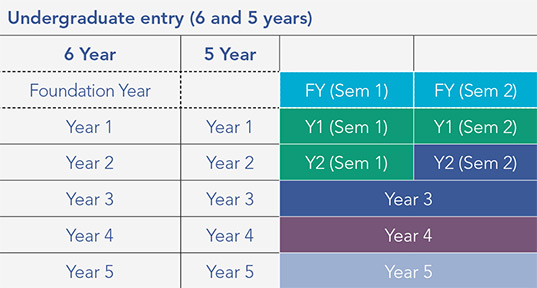
The Medicine programme for School Leavers and Mature Entry students is outlined below:
- Foundation Year (two semesters)
- Year 1 (two semesters)
- Year 2 (two semesters)
- Year 3
- Year 4 (Senior Cycle 1)
- Year 5 (Senior Cycle 2)


MB, BCh, BAO (Hons)
School of Medicine
The Medicine programme for School Leavers and Mature Entry students is outlined below:
The five-year programme is organised into three stages: Foundation of Practice (Years 1-2), Integration into Practice (Year 3) and Preparation for Practice (Years 4-5).
The six-year track includes an additional Foundation Year before Year 1. Learning is built around three core pillars: Knowledge (Head), Skills (Hands) and Personal and Professional Identity (Heart). Below is a detailed outline of the modules you will study throughout the programme.
Case-based learning (CBL) is a core teaching and learning approach in Years 1 and 2. You work in groups of approximately 12 students with a facilitator and have the opportunity to choose from a wide range of tailored and credit-bearing student choice topics. These experiences support your personal growth.
Each medicine student is assigned a Personal Tutor who supports them throughout their time at RCSI. The Personal Tutor Programme aims to give you a safe space to reflect on your academic, personal and professional performance, assist you by ensuring you have the relevant supports (academic, well-being and so on), provide resource and referral information to enable you to move towards improvement and encourage you to establish habits of continuous reflection, goal-setting and lifelong learning.
Students are evaluated using programmatic assessment and the application of a grade point average (GPA) scale. This approach provides multiple opportunities for measurement, coupled with ongoing feedback during the learning process. It reduces emphasis on end-of-semester or end-of-year high-stakes assessment and provides a range of different assessment types to facilitate the measurement of competencies.
RCSI Medicine students are also placed in one of six learning communities, which are groups of students actively engaged in learning with and from each other. These communities include students from every year in your programme and are an integral part of our teaching philosophy in the education of future healthcare professionals. The learning communities allow you to build academic relationships with your peers and support each other in your learning. You are also part of a broader inter-professional learning community made up of students from other programmes, which facilitates participation in specific inter-professional academic activities.
At RCSI, our curriculum is informed by principles of positive education. This combines the science of positive psychology with curriculum development, delivery and assessment. As part of the core curriculum, you are taught skills and behaviours that encourage you to prioritise your health and well-being, supporting your capacity to flourish. This approach to learning actively promotes positive growth, resilience and well-being.
Foundation Year (FY) consists of two semesters – delivered from September to May of the first year in the six-year Medicine programme.
FY will provide you with a solid grounding in the biomedical sciences and professionalism, as well as the necessary IT skills to operate efficiently within the University's virtual learning environment (VLE).
The course is delivered as a series of stand-alone modules taught in a single semester and integrated, systems-based modules, delivered across two semesters.
The FY structure is as follows:
First semester
Second semester
Both semesters
In Year 1, you will learn the basic anatomical, molecular and biochemical bases of human life, the principles of pharmacology, and acquire a basic understanding of the epidemiology and mechanisms of disease. You will also learn about musculoskeletal and skin systems, and how to diagnose and manage common and important cardiovascular and respiratory disease.
Student Choice modules will facilitate your exposure to various social and environmental experiences that will enable personal growth and the formation of your professional identity.
Case based learning (CBL) is a teaching tool used throughout Year 1. This is a learner-centered approach that involves interaction between students (up to 12). It focuses on the building of knowledge through group work.
CBL encourages the application of basic science knowledge, the linkage of knowledge between the basic and clinical sciences, a deeper understanding of content, and the development of clinical reasoning skills.
First semester
Second semester
Through an integrated teaching and learning approach, Year 2 modules are focused on ensuring that you gain the necessary knowledge and skills to communicate effectively and to work professionally and collaboratively to diagnose and manage common and important gastrointestinal and hepatological, central nervous system, endocrine and breast, renal and male and female genito-urinary diseases.
You will use an evidence-based approach that is grounded in best practice and safe patient care. Student Choice will continue to be integrated and you will have continuing opportunities to explore areas of interest such as innovation in research, education, global health, health systems and translational medicine. The Preparation for Clinical Placement module will teach you how to navigate the hospital environment prior to clinical placements in Year 3.
First semester
Second semester
During this year, your class will be divided and you will undertake prescribed modules at different times throughout the year. You will participate in hospital-based clinical placements and be located in one of the RCSI-affiliated teaching hospitals throughout Ireland. You will build on the knowledge and understanding of normal biology and diseases acquired during Years 1 and 2 and have the opportunity to apply this knowledge to real patients in multidisciplinary clinical settings.
Building on other relevant learning from Years 1 and 2, the New Horizons and Simulation module will provide you with the framework to interact and engage with a variety of new technologies that are being translated from the research to the clinical domain, including genomics and novel imaging approaches. You will also participate in a student selected component, where you complete an individual research or audit project.
Students will also have options relating to research projects overseas.
Year 3 modules
Year 4 modules will provide you with wide-ranging clinical exposure running in parallel with an integrated teaching and learning programme that focusses on knowledge and skills in areas including clinical competence, professionalism, communication, scholarship, leadership and global outlook.
You will be anchored full-time within a clinical team at an RCSI Teaching Hospital working in medicine, obstetrics and gynaecology, psychiatry, surgery, paediatrics, child health and general practice.
You will have the opportunity to practise your clinical skills and take an active part in the care pathways of individual patients, while simultaneously gaining experience in multi-disciplinary frameworks in both hospitals and community settings.
Year 4 modules
Year 5 will represent your final stage of preparation towards becoming a practising clinician. Student Choice Clinical Elective is an eight-week clinical attachment. Four weeks can be completed in any clinical discipline, and four weeks have to be completed in adult in-patient medicine or surgery. There are opportunities to complete all eight weeks during summer outside RCSI and receive credit.
The Advanced Clinical Practice module is an eight-week integrated medicine and surgery module. The module combines didactic teaching with practical, clinically focused learning, enabling students to consolidate and apply knowledge from across the medical and surgical curriculum. Through a combination of classroom and clinical teaching, the module supports students in integrating knowledge with effective communication, decision-making and patient-centred care, while developing the competencies required for clinical practice.
The Clinical Clerkship is a 12-week programme, consisting of medicine (Clinical Clerkship 1) and surgery (Clinical Clerkship 2) attachments followed by a preparation-for-practice component (Clinical Clerkship 3), incorporating intern shadowing, simulation-based education, workshops and practical skills training. Through supervised clinical experience, students consolidate their learning while strengthening clinical reasoning, communication, teamwork and practical skills in preparation for the transition to internship.
First and second semester
Meet Dr Gozie Offiah, Senior Lecturer and Director of Curriculum Implementation who explains our learning philosophy and how we integrate clinical and communication skills with knowledge acquisition and the formation of professional identity.
Your learning community will allow you to connect with students from other years, both academically and socially, throughout your programme. Learn more about the six communities in the School of Medicine and how they will shape your RCSI experience.
Find out about the wide range of teaching methods you will experience as an RCSI Medicine student. From our Anatomy Room, built more than 200 years ago, to our high-tech simulation labs – best practice and innovation are central to your learning.
Formative assessment will help you to track your progress and decide how best to integrate feedback during your learning journey. Engagement with your personal tutor and your personalised e-portfolio will support your progress.
Learn more about our wide range of student supports available to you. We have a large multidisciplinary team that can help you to overcome educational challenges and provide training and guidance as well as practical and emotional support.
Discover how your exposure to clinical experiences at the earliest stages of your programme will shape your learning at RCSI. You will take increasing levels of clinical responsibility throughout your degree and experience domiciliary, community and hospital care settings.
RCSI places a high value on supporting international clinical experiences for our students. Accordingly – through a network of international partnerships with other world-leading universities and healthcare institutions – we offer a significant number of clinical elective opportunities.
Learn more about the RCSI Research Summer School, research electives and other intensive experiences that allow you to be exposed to core research skills in topics such as scientific writing, presentation, data management, statistics and ethics.
As an RCSI student, you will attend a wide variety of public, private and specialist teaching hospitals and clinical sites where you will learn to hone your clinical and professional skills. Learn more about our teaching hospitals and clinical sites.